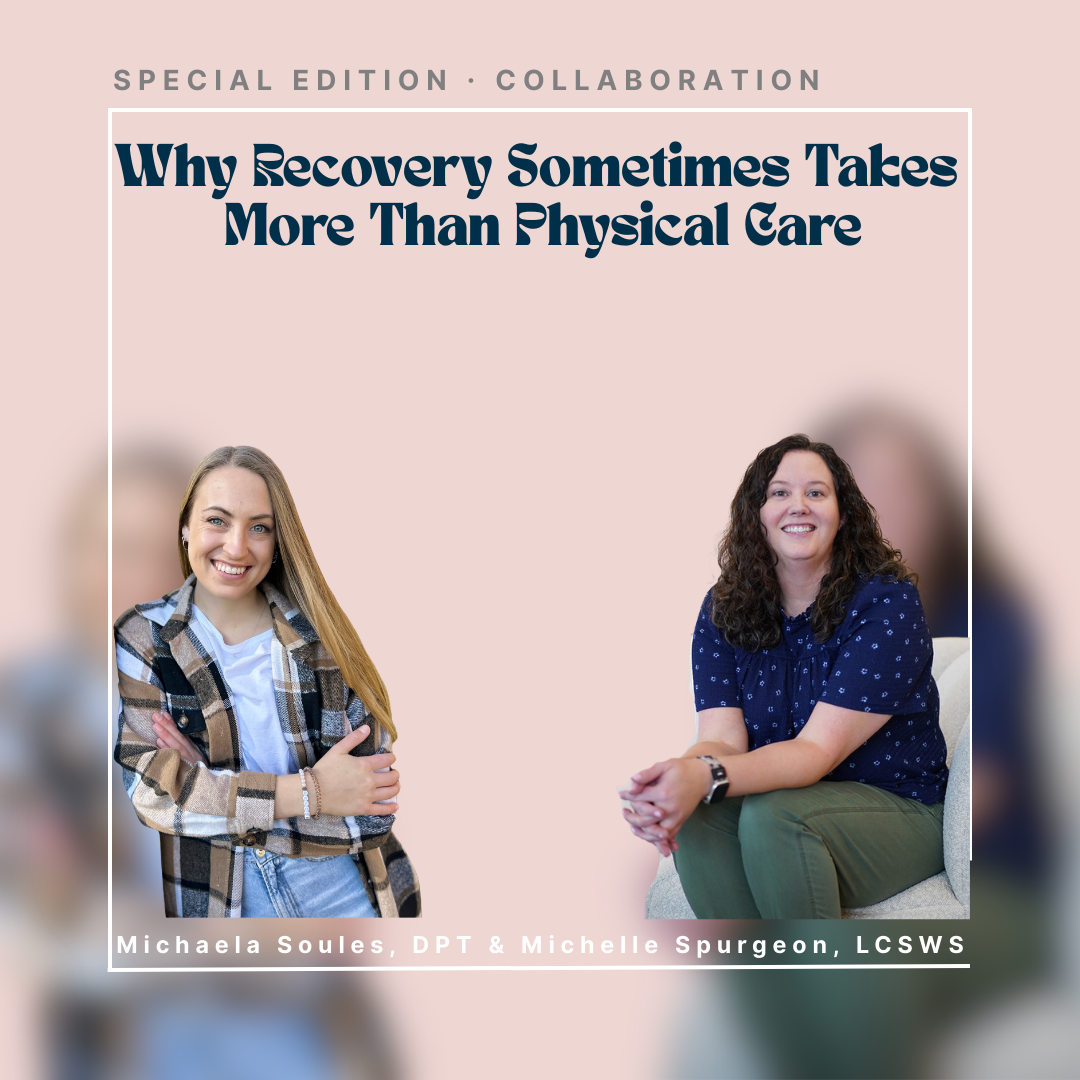
This blog shares from two different helping professionals who support folks pre and post surgery and in recovery from injuries. Dr. Michaela Soules PT, DPT is a dedicated physical therapist and certified life coach who created Soul Strength for one purpose: empower clients to successfully navigate their recovery after surgery or life-altering injuries. Michelle Spurgeon, LCSWS is an EMDR therapist who can support clients pre-surgery or in recovery to create effective coping plans, heal from medical trauma or strengthen their inner-self for recovery.
Injury or surgery doesn’t just affect the body- it can affect your nervous system, identity, sense of safety, and trust in yourself. Yet most recovery plans focus almost exclusively on the physical needs: range of motion, strength, post-op timelines, and milestones in physical therapy.
For many people, especially those who are capable, driven, and used to handling things- this can be confusing. You’re doing everything you’re “supposed” to do- attending appointments, following protocols, staying motivated- yet still feel anxious, unsettled, or disconnected from your body.
Michaela: What types of clients tend to struggle the most with traditional PT-only models?
Many of the clients I work with are doing everything right on paper like showing up to PT, completing exercises, following protocols, and still feel stuck.
Traditional PT models can unintentionally fall short for people who have:
lived through medical trauma
undergone multiple surgeries
dealt with chronic pain
or learned to push through discomfort long before their body felt safe
These clients don’t just need stronger muscles, they need support rebuilding trust in their body. When recovery is treated as purely mechanical, the emotional and nervous system layers are often overlooked. That’s where frustration, fear, and self-doubt quietly take root, slowing healing even when clients might be improving physically.
Michelle: Why do capable, high-functioning people often struggle emotionally during recovery?
Go-getters are often skilled at self-regulation through doing: staying busy, solving problems, pushing through discomfort, and caring for others. Injury or surgery disrupts these tried and true strategies. When the body suddenly limits productivity, independence, or control, there is often a profound emotional impact that takes people by surprise.
For many, recovery brings up vulnerability they’ve rarely had to sit with—dependence on others, uncertainty about outcomes, and the inability to “fix” the problem through effort alone. This can activate shame, fear, grief, or a sense of failure, even when they intellectually know healing takes time.
Capable folks are also more likely to minimize their own emotional needs, telling themselves they should be handling it better. But the body doesn’t always respond to logic—it responds to safety, support, and permission to slow down.
Therapy helps high-functioning clients shift from self-pressure to self-attunement, allowing recovery to become a relational and embodied process rather than another performance to manage. I also work with clients before surgeries through EMDR therapy to help get ahead of some of these patterns and develop other ways of copings for recovery.
Michaela: How do chronic pain or post-surgical clients often “overdo it” or “underdo it” without realizing it?
I see this all the time, and it’s rarely about motivation. Overdoing usually causes setbacks and pain, while underdoing creates muscle and joint stiffness as well as pain.
Some clients overdo it because they’re trying to “prove” they’re okay by pushing through pain, skipping rest, or rushing milestones out of fear of falling behind (usually this is a deep rooted fear of lack of control). Others underdo it because their body learned that movement = danger (nervous system threat), so they unconsciously avoid mobility even when they’re physically capable.
Both patterns come from the same place: a nervous system dysregulation that doesn’t feel safe yet.
Without guidance that accounts for pacing, self-awareness, and emotional context, people end up stuck in a loop swinging between pushing too hard and pulling back too much, never quite finding their sustainable middle ground. Our goal with working together is about finding that middle ground.
Michelle: What role does medical trauma play in stalled healing?
Medical trauma and being dismissed by providers can affect the body’s sense of safety—often in ways that aren’t obvious at first. When someone has felt ignored, minimized, rushed, or disbelieved by medical providers, the nervous system may stay in a state of threat long after the procedure or injury has healed.
Instead of interpreting pain or sensations neutrally, the body can become hypervigilant with the message- Something is wrong. I won’t be listened to. I have to stay on guard. This can increase muscle tension and make rest or movement feel unsafe. For some people, medical settings or even recovery exercises unconsciously cue the same powerlessness or fear they experienced during treatment.
Having your concerns or needs dismissed is especially difficult because it teaches the body not to trust its own signals. Clients may swing between ignoring pain entirely and panicking with certain sensations. Healing stalls not because the body is incapable, but because it doesn’t yet feel protected.
In therapy, we work to restore a sense of agency and trust in the body—helping clients process what happened, name the rupture, and re-establish a felt sense of safety so the body no longer has to stay braced against further harm. I often use EMDR therapy to help with this.
Michelle: How does therapy help someone tolerate uncertainty and vulnerability in healing?
Healing—especially physical recovery—requires tolerating uncertainty: not knowing how long it will take, how the body will respond, or whether setbacks will occur. That is really hard to tolerate, right? Uncertainty can feel threatening rather than neutral, especially if someone’s history includes trauma, unpredictability, or loss of control.
Therapy helps by strengthening the brain and body’s capacity to stay present with what is rather than bracing against what might happen. Instead of forcing reassurance or positive thinking, we work on building internal safety—so sensations, emotions, and unknowns can be felt without overwhelming the system.
Through therapy, clients learn how to recognize when fear is driving the experience versus when the body is genuinely signaling danger. They practice self-compassion, boundary setting, and emotional regulation that allow vulnerability without collapse.
Over time, uncertainty becomes less of a threat and more of a space where the body can adapt, respond, and heal. This emotional flexibility often supports physical recovery in ways no amount of willpower can.
Michaela: How do you help clients rebuild trust in their body without pushing them past safety?
Rebuilding trust isn’t about forcing confidence, it’s about creating repeated experiences of safety. When we're healing, our body's "alarm system" is on high alert, so what works is teaching your body and mind how to manage fear and self-regulate without ignoring those signals. What I teach my clients is "go to the facts" what did your body tell you or show you, versus what is your mind telling you to fear.
We start small. We focus on consistency over intensity. Clients learn how to listen for subtle body cues instead of ignoring or overriding them, and how to differentiate discomfort from danger (pain doesn't always = tissue damage, and this is key). Each win, no matter how small, becomes evidence: My body can handle this. I’m not broken.
Over time, trust grows because my client is no longer fighting their body, instead they’re working with it. That’s when internal strength starts to build, and recovery shifts.
Michaela: What changes when recovery is paced around nervous system capacity instead of timelines?
Everything softens and the weight is lifted. Usually, progress often speeds up. When recovery is paced around nervous system capacity, clients stop measuring themselves against arbitrary timelines and start tuning into what their body is actually ready for. There’s less panic, less self-criticism, less judgement, and more curiosity.
Healing becomes sustainable. Setbacks feel less catastrophic and just part of the progress. And clients begin to experience recovery not as something happening to them, but something they’re actively participating in. Clients feel a sense of agency, compassion, and resilience towards themselves and their recovery.
Why Mind-Body Care Changes the Recovery Experience
When recovery addresses both the body and the nervous system, something important can shift. Pain becomes more understandable. Fear becomes less overwhelming. Progress feels steadier. Progress can feel steadier as you are supported to listen to the needs of your mind and body.
Working with providers to help care for all of you means you’re not asked to choose between emotional support or physical progress. You can receive coordinated care that honors how stress, trauma, fear, and loss of control can impact your healing. Coaching helps translate safety and trust back into movement, and feel confident and capable at every stage of the healing process. Therapy helps prepare you before planned procedures, or process the emotional responses and experiences that can stall recovery.
If recovery has felt heavier, slower, or more emotionally charged than you anticipated- you don’t have to navigate this alone. Reach out to Michaela Soules of Soul Strength for coaching, or Michelle Spurgeon of Steady Healing for therapy support (in TX, FL, LA, or VA).
More About the Authors
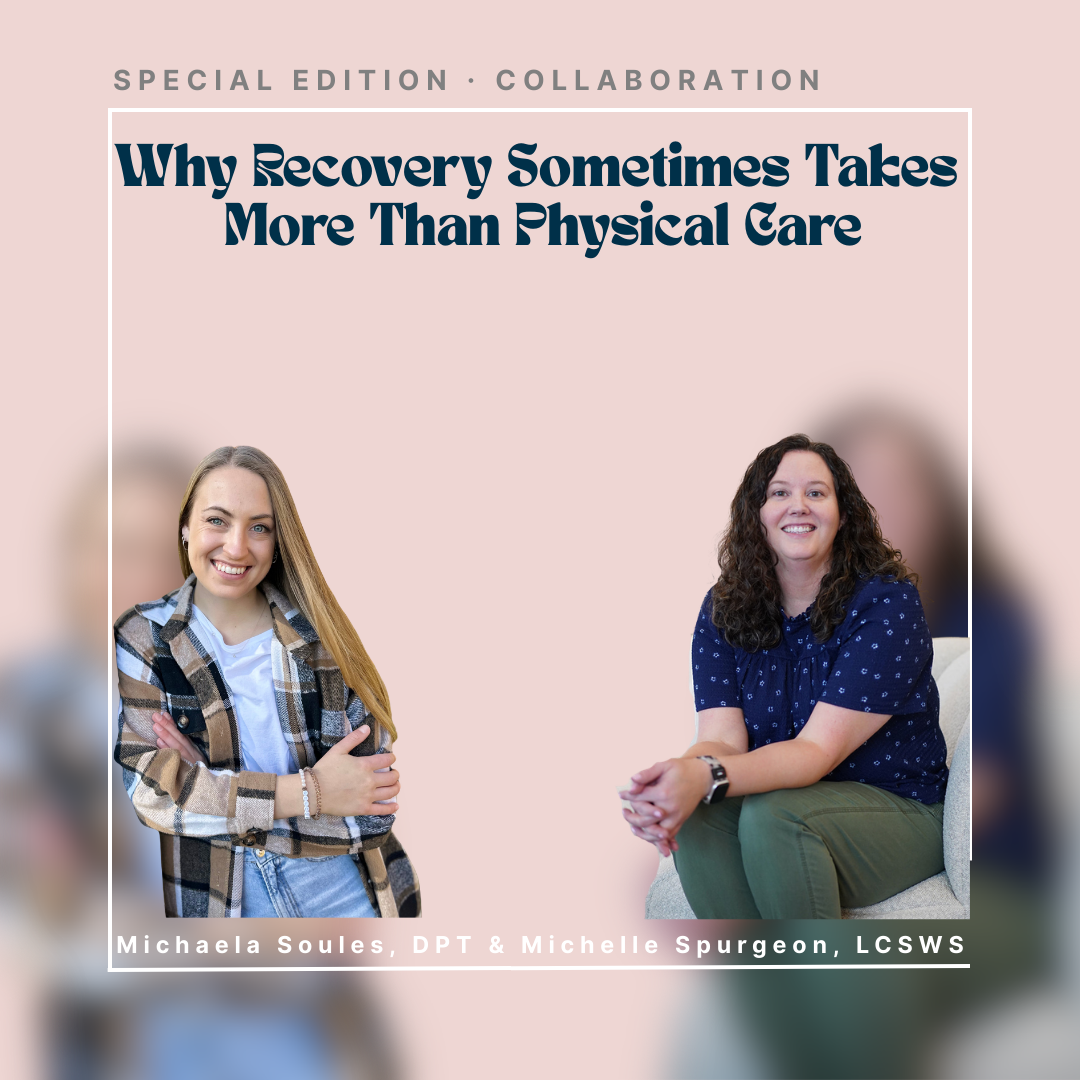
This blog shares from two different helping professionals who support folks pre and post surgery and in recovery from injuries. Dr. Michaela Soules PT, DPT is a dedicated physical therapist and certified life coach who created Soul Strength for one purpose: empower clients to successfully navigate their recovery after surgery or life-altering injuries.
Michelle Spurgeon, LCSWS is an EMDR therapist who can support clients pre-surgery or in recovery to create effective coping plans, heal from medical trauma or strengthen their inner-self for recovery. Michelle serves clients in her Dallas therapy office and online across Texas, Florida, Louisiana, and Virginia.